Us Drawing Up Plans for Korea
U.S. President Joe Biden this week was asked what the U.South. withdrawal from Afghanistan ways for Washington's other global armed services commitments. In response, Biden stressed the "fundamental difference" between Transitional islamic state of afghanistan and places similar South Korea, where the U.S. also has a major troop presence.
It would be hard, if not incommunicable, to notice a S Korean who disagrees with that assessment. There are obvious differences between Afghanistan, one of the earth'southward poorest and least-developed countries, and Republic of korea, a stable democracy and U.S. treaty ally that has the world's tenth largest economy and sixth nigh powerful military.
Yet, the messy U.Due south. retreat from Afghanistan, and the ensuing Taliban takeover, has intensified questions hither most how much Southward Korea should depend on long-term U.Southward. armed forces protection and whether Seoul should do more than to look after its ain defense. Specifically, information technology may amplify voices who desire South Korea to pursue its own nuclear deterrent.
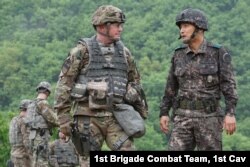
The U.S. has nearly thirty,000 troops in South Korea, a remnant of the 1950s Korean State of war that concluded in an armistice rather than a peace treaty. Although it has been decades since major hostilities, U.South. troops remain as a deterrent to the nuclear-armed and often belligerent Democratic people's republic of korea.
Few recall the U.South. military will withdraw from South Korea anytime shortly. Biden's national security adviser, Jake Sullivan, said this week the U.Due south. has "no intention of cartoon downwards forces" from South Korea.
What explains the concerns?
Doubts about long-term U.South. military commitment are rooted partly in South Korea'south experience with former U.S. President Donald Trump, whose "America First" strange policy consistently strained the seven-decade-old alliance.
Trump not only demanded Due south Korea pay a bigger share of the cost of U.S. troops, he at times questioned whether the troops were necessary at all.
As a candidate, Trump even suggested South Korea and Japan get their own nuclear weapons, and threatened to withdraw troops from both countries, if they did not pay more for protection.
Those kinds of statements are hard to forget, said Park Won-gon, a professor at Ewha Womans University in Seoul.
"South Korea has experienced the past four years under the Trump administration, and we are not 100% certain the U.Due south. won't go back to this," Park said.
Larger US trends at play
Trump isn't the only factor for Due south Korea to consider. Growing segments on both sides of the U.S. electorate are skeptical of U.Due south. armed forces involvement overseas.
Many Trump-allied Republicans now oppose what they call U.S. "forever wars." On the left, loftier-profile politicians, such as Senator Bernie Sanders and Representative Alexandria Ocasio-Cortez, telephone call for drastically reducing the Pentagon budget, forth with a more than restrained global agenda.
Those views are concerning to Chun In-bum, a retired South Korean lieutenant general, who worries many Americans don't run into the value in having troops in South Korea.
"They don't realize the stability that comes with it. They don't realize the security that comes with that stability. They don't realize the economical benefits that come from that stability and security. And that really concerns me," Chun said.
Nuclear concerns
The U.South.-Republic of korea alliance already faced significant challenges, mostly from Democratic people's republic of korea.
Although Due south Korea'south conventional forces are vastly superior to the North'due south, Pyongyang has one affair that Seoul doesn't, nuclear weapons. Instead, Republic of korea relies on the so-called U.S. nuclear umbrella of protection.
In recent years, though, at that place accept been more calls for Republic of korea to pursue nuclear weapons in some form, either through domestic development or the restationing of U.South. tactical nuclear weapons that were removed in the early 1990s.
Since the U.S. withdrawal from Afghanistan, at that place take already been renewed calls for South korea to acquire nuclear weapons.
In a Facebook post this week, conservative Due south Korean lawmaker Thae Yong-ho proposed Seoul pursue either a NATO-manner nuclear sharing organization or that it restore U.S. tactical nuclear weapons.
If North korea does not denuclearize past 2027, Thae said, the South "should present a strategic timetable to the United States and China and announce that we will inevitably pursue nuclear development."
"The lesson for u.s. from the Afghan crisis is that there are no permanent enemies or permanent allies in this earth. At that place is simply national interest," said Thae, who defected to South korea afterwards working every bit a Due north Korean diplomat.
South korea briefly pursued an illicit nuclear program in the 1970s, when at that place were also concerns about U.Due south. military commitment. It abandoned that effort several years later.
In contempo years, some opinion polls suggest the South Korean public would support domestic nuclear weapons development.
"The very serious and fundamental problem is that we, South Korea, do not have any capability of nuclear deterrence. We have to rely 100% on the United States," Park said.
Sovereignty debate
Another point of alliance tension is whether and at what speed South Korea should regain more than control of its forces during a hypothetical state of war.
In 1950, Republic of korea handed command say-so of its troops to the U.S. in club to fend off a Due north Korean assault during the early stages of the Korean War. The U.S. retained that say-so until 1994, when South korea assumed peacetime "operational control" of its forces.
Under the current arrangement, the U.Southward. would withal control certain aspects of Republic of korea's armed services if war broke out. Some left-leaning South Korean politicians object to that prospect and want the organization to exist inverse as soon as possible.
Song Young-gil, who heads Southward Korea'south ruling Democratic Party, said the U.Due south. withdrawal from Transitional islamic state of afghanistan is the latest show Seoul should speed upward the so-called "OPCON transition."
"If you accept no feel in planning and executing your own operations, you do not know what kind of trouble you will face as a nation," Vocal said in a Facebook mail service.
Chun, the erstwhile lieutenant-general, disagreed. Such a transition, he said, could jeopardize the U.S.-Republic of korea alliance, ultimately making South Korea less safe.
"Due south Koreans demand to realize that if we have OPCON transition in that location'll be a possibility of a disconnect between the 2 allied forces who are right now attached at the hip," Chun said.
The event already causes friction in the U.Due south.-South Korea relationship, though more often than not beneath the surface.
The U.S. and S Korea agreed in 2018 to begin a 3-stage process for assessing whether Seoul is ready to regain wartime control.
South Korean President Moon Jae-in says he would like to complete the transfer by the end of his term in May 2022. U.S. officials, yet, warn against imposing a time limit, saying the transition should instead be conditions-based.
Any attempt to rush the upshot volition "do damage to the relationship we have right now," Chun said. "And the relationship nosotros accept right now is pretty good," he added.
Ties growing
In fact, the U.S.-Southward Korea alliance has recently expanded to focus on other regional and global issues, such every bit the coronavirus pandemic, climate modify, and Red china's growing assertiveness.
Many South Korean analysts believe the Korean peninsula is a core national involvement for the U.s.a.. Opinion polls suggest broad public back up in both countries for the U.Due south. troop presence. There are no signs that will change, especially as the U.South.-Prc rivalry intensifies.
"It's pretty clear that the U.Due south. has tried to motility from the Middle East to focus on the so-called Indo-Pacific expanse," Park said, adding that "South korea is one of the, if not the nearly, important allies in this region."
Source: https://www.voanews.com/a/usa_how-afghanistan-withdrawal-looks-south-korea-americas-other-forever-war/6209777.html
0 Response to "Us Drawing Up Plans for Korea"
Post a Comment